- Blog
- Technical
Your customer no longer googles. They ask.
What changes for your website when people increasingly ask an AI instead of searching, and what you can do about it tomorrow. A checklist, an example service page and a way to check whether it works.
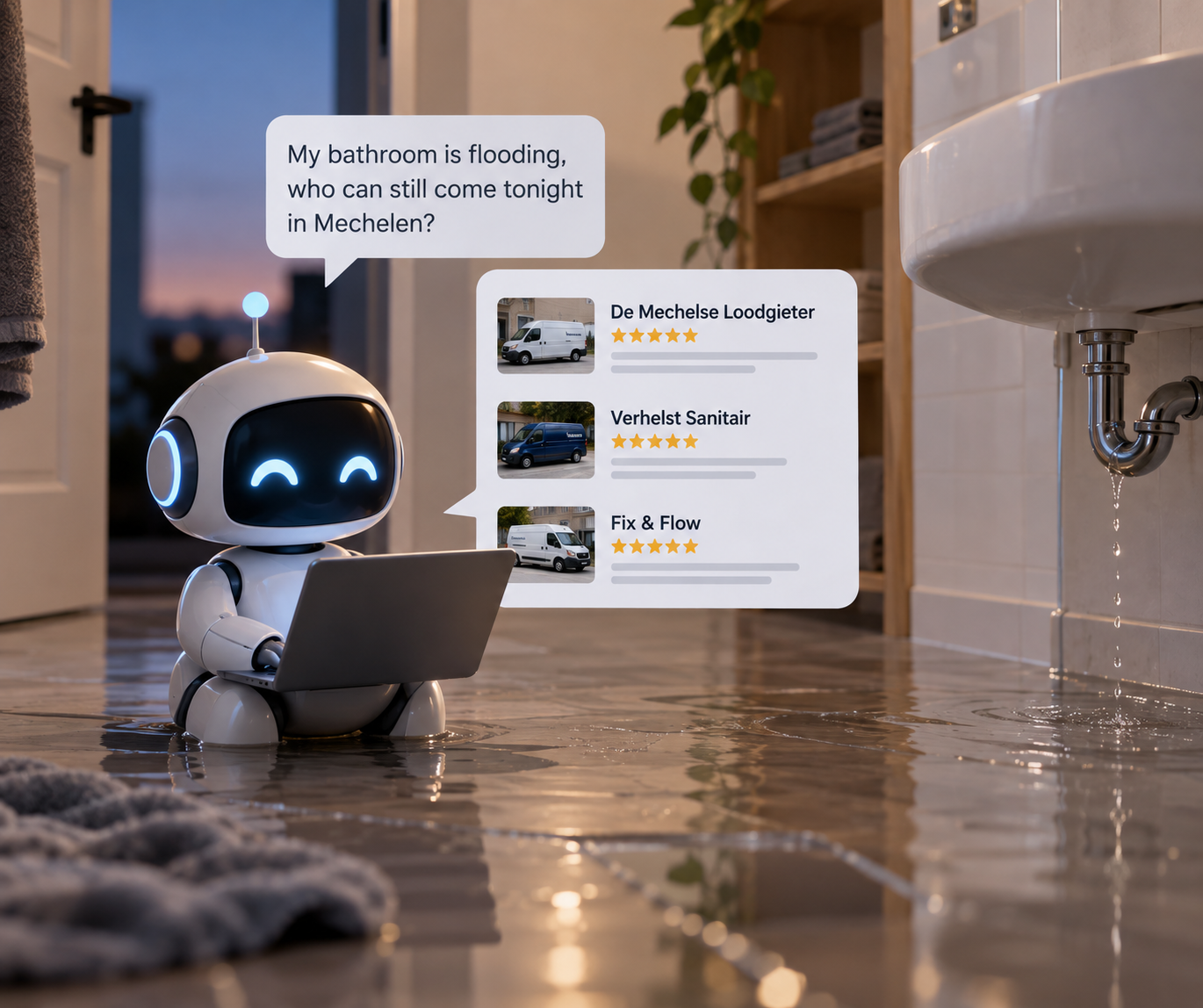
Saturday evening, a quarter to nine. The water in Els's bathroom is a centimetre deep. She doesn't open Google, doesn't scroll past four ads and doesn't click through ten websites. She types one sentence into a chat window: 'My bathroom is flooding, who can still come tonight in Mechelen?' And one answer comes back. With three names.
Whether your business is among them depends on something most entrepreneurs have never looked at: can a machine read your website?
Your website has two kinds of visitors: people, and machines that read on behalf of people.
What is changing
More and more people let an AI assistant, such as ChatGPT, Perplexity, Gemini or Claude, look up the answer instead of browsing themselves. Such an assistant reads websites, pulls out the facts and summarises them. The clearer your facts, the easier it is for it to use them.
Nobody can promise that an AI will mention you. But a site that a machine understands is also understood faster by people. And a photo of your van tells a machine nothing. A sentence under that photo does.
How an assistant arrives at its answer
How an assistant works exactly differs per product and changes quickly. Some search the web live and name their sources, others answer mostly from what they learned earlier. For you it comes down to the same thing: the clearer, more current and more consistent your information is on the web, the greater the chance an assistant reflects it well. There is no guarantee.
What a machine wants to find on your site
- What you do, in plain words.
- Where you work: municipalities or region.
- Who you work for.
- Roughly what it costs, or how a customer can work that out.
- How and when you can be reached.
- The questions you always get, with an honest answer.
A service page that machines understand
An example, for a made-up plumber in Mechelen. Note how each part is a short, factual sentence:
- What: Leak detection, repairs and emergency call-outs for homes and small businesses.
- Where: Mechelen, Duffel and surrounding municipalities.
- For whom: Private customers and small businesses.
- Price: Call-out from [amount], travel included. Quote for larger jobs.
- Reachable: Every day from 7 am to 9 pm, emergency number day and night.
- Questions: What does an emergency call-out cost? When can you be there? Does my insurance cover this?
What doesn't work
- Stuffing words. 'Cheap plumber Mechelen, plumber Mechelen cheap.' Nobody reads that, human or machine.
- Contradictory details. A different address on your site, your Google profile and your social media.
- Outdated prices and hours. An assistant that repeats your old details does neither you nor your customer any favours.
- Everything in images or PDFs. Without plain text there is nothing to read.
What you can do tomorrow
- Put the basics in plain text on your homepage. No text that only exists inside an image.
- Write a page with frequently asked questions. With the real questions customers ask, and honest answers.
- Add structured data. These are labels that tell machines what a service is, where you are and what it costs.
- Keep your details the same everywhere. Website, Google Business Profile and social media must say the same thing.
- Don't block assistants. Check your robots.txt, and consider a short plain-text summary for assistants. A proposal for that is called llms.txt. Whether it works is not yet proven.
How to check whether it works
Ask a few assistants the questions your customers ask, for example: 'Who is a good plumber in Mechelen?' See whether you are mentioned, and above all whether the facts are right. Do this every month, write down what you see and don't count on a single result: answers differ per day and per assistant.
An honest note
Whoever promises to put you at the top of ChatGPT is selling hot air. Nobody controls the answers of an AI. What you can do is offer clear information. That always wins, with people and with machines. A website that a robot understands, your aunt understands too.
Els doesn't exist. Her flooded bathroom does, for someone, right now.
How readable is your site for machines?
We are happy to look at your website through the eyes of an AI assistant, and tell you honestly what could be better.
Comments
No comments yet. Be the first to share your thoughts.